
Master in Biological and Medical Engineering
About the program
The Master’s in Biological and Medical Engineering at the Pontificia is a graduate academic program designed to train professionals with advanced skills to integrate knowledge from engineering, the biological sciences, and medicine in order to develop innovative solutions to complex challenges in health and the life sciences.
The program provides a solid, research-based scientific and technological education that enables students to develop the skills to formulate, execute, and lead applied research and technological innovation projects. Its interdisciplinary approach promotes the integration of engineering methodologies with biomedical sciences to develop new knowledge, devices, technologies, and tools that contribute to the diagnosis, treatment, prevention, and understanding of diseases, as well as to the improvement of health care systems.
It is intended for professionals with degrees in fields related to engineering, biology, or medicine, holding a degree from a university recognized by the Chilean government or, in the case of foreign institutions, by the government of the respective country; who wish to specialize in the development of technologies that have an innovative impact on the medical field.
Students can deepen their knowledge in various areas of biological and medical engineering, including biomaterials, biomechanics, medical imaging, biomedical signal processing, tissue engineering, computational biology, bioinformatics, artificial intelligence applied to healthcare, precision medicine, medical devices, and other lines of research conducted by the Institute of Biological and Medical Engineering.
Graduates of the program are prepared to work at universities and research centers, healthcare institutions, medical technology, biotechnology, and pharmaceutical companies, public and private organizations, as well as in science- and technology-based innovation and entrepreneurship initiatives. Furthermore, the program provides a solid foundation for pursuing doctoral studies and contributing to the country’s scientific and technological development.
This program aims to help students develop skills in the research methods and techniques specific to historiography, thereby strengthening their ability to think historically. This approach allows students to propose and develop their research projects and theses on a variety of topics related to the past.
For more information, click here.
Los egresados del Magíster en Ingeniería Biológica y Médica deberán ser capaces de:
- Desarrollar e implementar soluciones a problemas complejos que requieran de la aplicación simultánea de conocimientos interdisciplinarios proporcionados por la Ingeniería, la Medicina y la Biología a partir de su sólida formación científica y tecnológica.
- Promover la transferencia de tecnología hacia la sociedad a través de procesos e investigaciones de carácter profesional generadas en la industria, la academia, o a través de emprendimientos de carácter tecnológico e innovador.
- Participar en grupos de investigación interdisciplinarios y desarrollar investigaciones experimentales y/o teóricas de relevancia tanto académica como social.
- Comunicar eficazmente de manera oral y escrita a la comunidad científica y a toda la sociedad.
- Desarrollar la investigación y el quehacer profesional en el ámbito interdisciplinar de la Ingeniería Biológica y Médica y su interacción con la sociedad y el medio ambiente con responsabilidad ética.
Los postulantes deberán contar con un título universitario o licenciatura en áreas relacionadas a las Ciencias Biológicas, Medicina o Ingeniería, y tener un nivel medio/alto de inglés demostrable en la entrevista con el comité. Así mismo, deberán mostrar un gran interés por la intersección entre estas disciplinas.
Conversaciones previas con los profesores del programa serán fuertemente valoradas en este proceso de selección. Por esta razón, se sugiere contactar a los profesores del IIBM antes de enviar los documentos requeridos.
– Copia de la solicitud de aplicación y comprobante de pago.
– Copia notarial del grado académico, certificado de ranking original y el histórico de notas por cada título obtenido. En el caso de postulantes extranjeros, se debe precisar la escala de evaluación utilizada y la nota mínima de aprobación. En adición, los certificados académicos de los estudiantes extranjeros deberán ser legalizados/apostillados en su país de origen. Formulario de postulación (388 KB) (datos personales, actividades académicas, docencia en postgrado, actividades de investigación, publicaciones y cualquier otra información relevante en inglés).
– Curriculum Vitae.
– Carta de intención en la que se expliquen los motivos por los cuáles se quiere aplicar al programa de Magíster, los logros académicos alcanzados y el potencial supervisor.
– Dos cartas de referencia, que deberán ser enviadas directamente al Comité de Magíster (postgrado.iibm@uc.cl).
Copia del RUT por ambas caras o pasaporte (primera página y copia de la visa).
– Carta de solicitud de beca (si aplica).
*Información referencial, puede obtener más detalle aquí: https://ingenieriabiologicaymedica.uc.cl/es/programas-de-estudio/postgrado/magister/perfil-de-egreso
Infórmate sobre aranceles, becas y alternativas de apoyo para tu formación.
 Ingresa aquí
Lines of Research





Curriculum
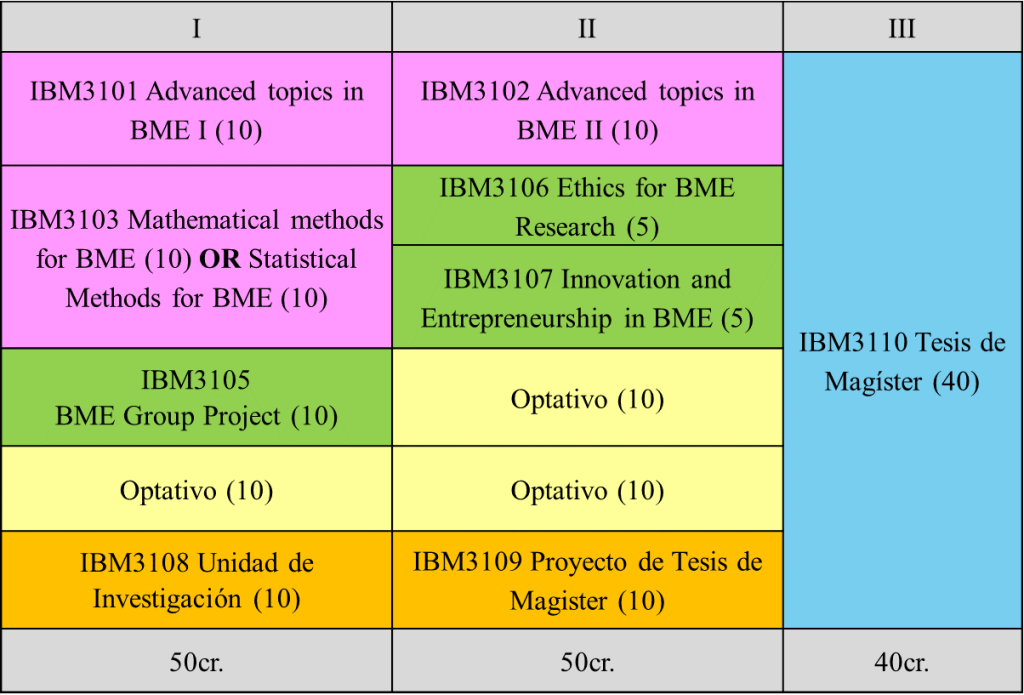
The Master’s Degree in Biological and Medical Engineering is an exclusive program, with a theoretical duration of 3 semesters and a total of 140 UC credits, of which 70 correspond to minimum courses, 30 to elective courses and 40 to Thesis. The credits are the quantitative expression of the academic work done by the student, necessary to achieve the objectives and learning achievements of each curricular activity. One UC credit is equivalent to one hour of work per week during a semester.
La Tesis de Magíster, que contempla 40 créditos, se realizará bajo la supervisión de uno o dos profesores-guía, y deberá demostrar la capacidad del alumno para plantear un problema, elaborar una hipótesis al respecto y desarrollar un trabajo de investigación individual en la interfaz de las ciencias biológicas, la medicina y la ingeniería. Se incentivarán las tesis realizadas bajo supervisión conjunta con objeto de fomentar la interdisciplina. Los co-supervisores ejercerán conjuntamente todas las funciones pertinentes y formarán parte del Comité de Tesis, compuesto además por el director del programa y por otros académicos del instituto y de otras instituciones externas a la UC.
Para conocer el Reglamento del Magíster, haga click aquí
People

Alejandro Aravena
Programa
Master in Biological and Medical Engineering
Tema de investigación
Emergence of Ising-type patterns in bacterial systems.

Carmen Meza
Programa
Master in Biological and Medical Engineering
Javiera Catalina Ortiz Méndez
Master’s Degree in Health Sciences Research-SA
Supervisor
Programa
Health Sciences-SA
Kristine Von Bischhoffshausen
Programa
Master in Biological and Medical Engineering
Tema de investigación
Upper airway in computed tomography
Rafael Kaempfer
Programa
Master in Engineering Sciences UC
The program’s faculty consists of 31 tenured professors, all of whom hold doctoral degrees, have active research interests, and boast distinguished academic careers. Faculty members meet the productivity standards defined by the National Accreditation Commission (CNA) for doctoral programs and are fully qualified to supervise master’s theses, serving as academic advisors to students in the program. Their experience and leadership in research ensure an excellent education and a high-level academic environment.


Cecilia Besa
Profesora Asistente Facultad de Medicina





Tomás Egaña
Assistant Director of Postgraduate Programs | Associate Professor

Andrea Ravasio
Associate Professor
Carlos Sing-Long
Associate Professor
Francisco Sahli
Associate Professor
Natalia Jimenez
Assistant Professor
Nicolás Garrido
Master’s student representative
Programa
Master in Biological and Medical Engineering
Sebastian Aguayo
Associate Professor
Tomás Egaña
Assistant Director of Postgraduate Programs | Associate Professor