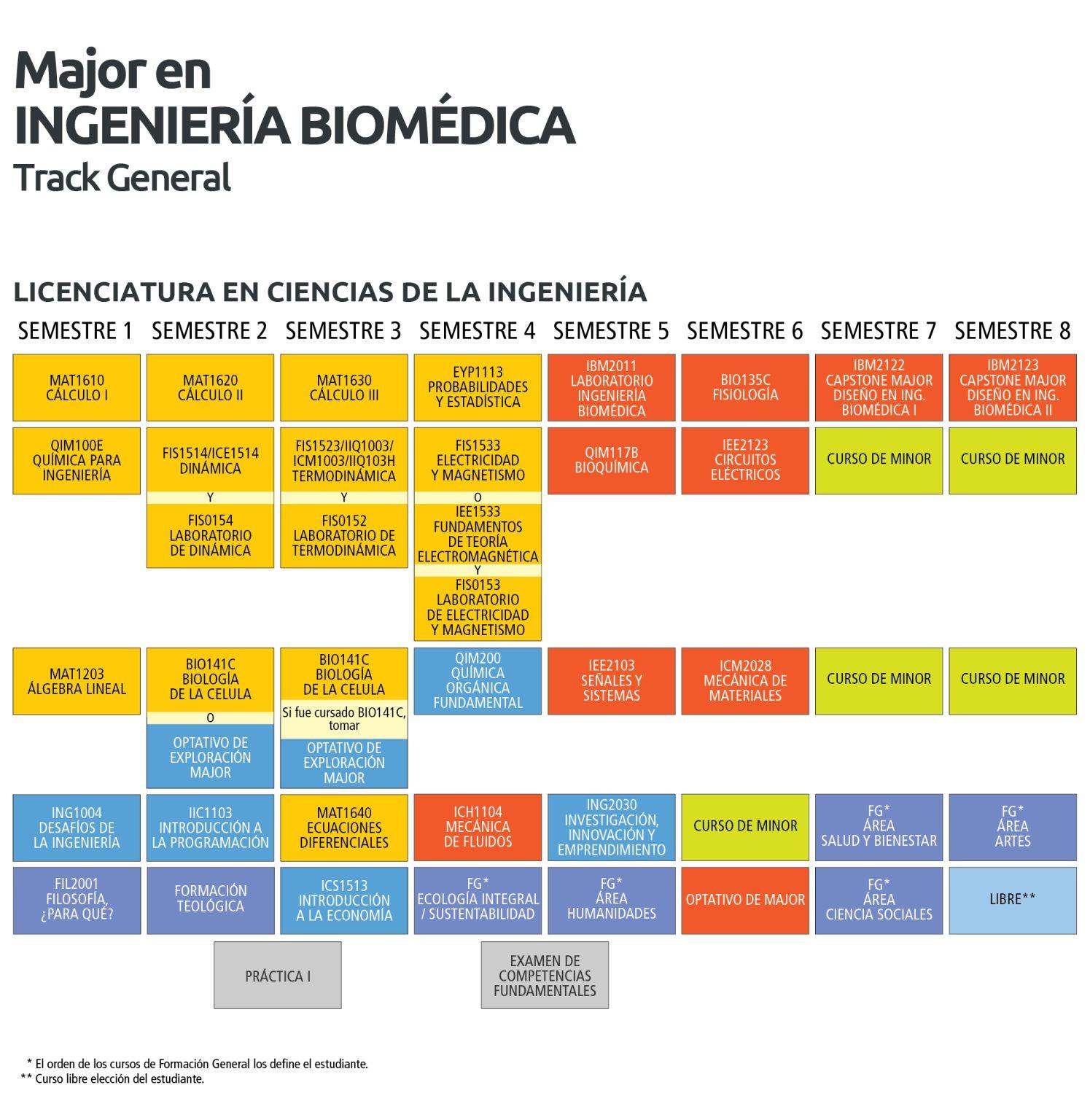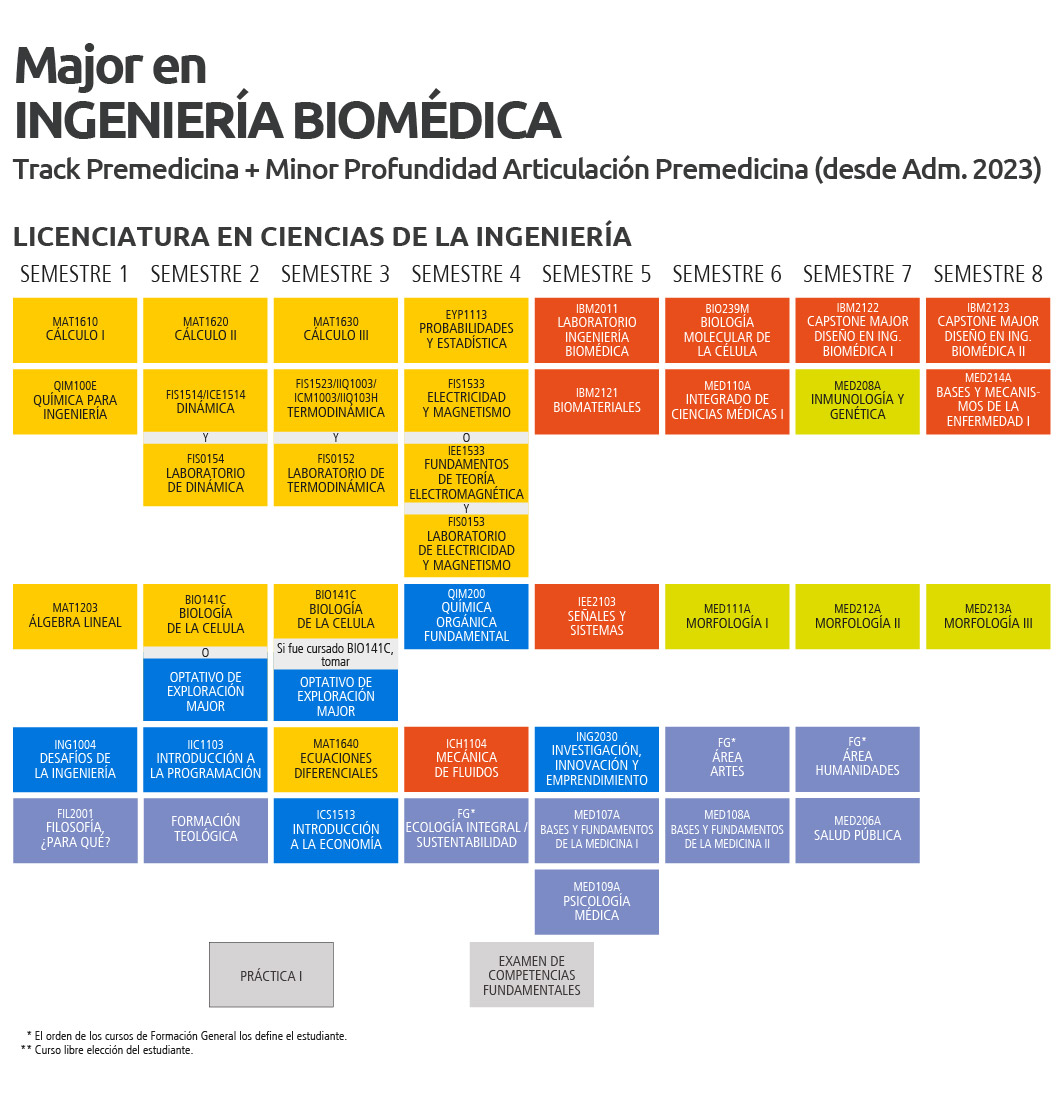
Major in Biomedical Engineering
About the program

Biomedical Engineering provides innovative and technological solutions to improve the quality of life of patients, optimize clinical processes and advance biomedical research through an interdisciplinary approach.
Through the Major in Biomedical Engineering, students will develop the ability to apply innovative solutions to health problems with an interdisciplinary approach, articulating their knowledge to perform in various projects. The program has a limited number of vacancies (24) so a selection process is required.
For more information visit the following site.
Curriculum


Continuity of studies
Students can opt for the following alternatives after completing their bachelor's degree:
- Continuation to a professional degree of Civil Engineer UC. Related degrees are: Civil Electrical or Mechanical Engineer and Civil Engineer of Industries with a Diploma in Mechanical Engineering or Electrical Engineering.
- Continuity to the UC Medical Surgeon degree in combination with the Premedicine Track (prior acceptance into the program).
- Continuity to the professional degree of Civil Engineer UC and articulation to the Master in Engineering Sciences, Master in Engineering or PhD in Engineering Sciences UC. Requires application to the Postgraduate program.
- To pursue a Master's or Doctoral degree in Biological and Medical Engineering. Requires application to the graduate program.
- Completion of a postgraduate degree (master's or doctorate) from UC or another institution. Requires application to the graduate program.
- Exit to the Labor Market: Entrepreneurship or early employment.
Student delegate Major
Frequently Asked Questions
- Companies specializing in diagnostic, monitoring, and medical therapy equipment
- Biomedical Technology Companies
- Pharmaceutical companies
- Biotechnology Companies
- Clinical Engineering Departments at Hospitals
- Universities and research institutes
- Agencies and companies specializing in health technology assessment and technology transfer
- Entrepreneurship – Innovation and Development
- Start-ups in general
The IIBM’s main areas of research are: Biomedical Imaging, Biomechanics and Quantitative Physiology, Cellular and Molecular Engineering, and Tissue Engineering.
Research conducted by a biomedical engineer draws on more quantitative tools (mathematics, biophysics). However, the nature of the research will depend on the researcher. It is also common to find biomedical engineers working in teams with biochemists, as these are highly complementary scientific disciplines.
The Biomedical Engineering major focuses on applications for human health using engineering as its primary tool, while the Biological Engineering major focuses on the use of biology (primarily cellular biology) as a tool for various applications, including medical, engineering, and process applications, among others. There is some overlap between the two programs.
Students enter the program through the common engineering curriculum. The common curriculum consists of basic science courses (mathematics, physics, chemistry) and cross-disciplinary skills that every engineer needs, regardless of their specialty. It is recommended that students take the exploratory course in the third semester, when they apply and declare their major. In the fourth semester, students take the first course in their major, and the common curriculum concludes.
The Biomedical Engineering major has a limited number of openings per admission year (24 students), so applicants must go through a selection process. Specific dates are announced annually by the Undergraduate Office of the UC School of Engineering.
The Bachelor’s Degree in Biomedical Engineering offers two paths to earning the professional degree:
- If a student follows the General Track, they complete their first cycle with a Bachelor of Science in Engineering and may subsequently continue on to one of the traditional degree programs offered by the School of Engineering.
- If a student chooses the Pre-Med Track—which allocates five spots per admission year—after being accepted and meeting the necessary requirements, they complete their first cycle by earning a Bachelor of Science in Engineering and then continue their studies in medicine. After completing the corresponding courses, the student earns the UC Doctor of Medicine degree. The Pre-Med Track does not qualify students to pursue a professional degree in engineering.
No, the professional degree in Biomedical Civil Engineering does not currently exist. After completing their bachelor’s degree, students can choose from the following options:
- Pathway to a professional degree in Civil Engineering from UC: Related degrees include Civil Engineering with a specialization in Electrical or Mechanical Engineering, and Industrial Civil Engineering with a diploma in Mechanical Engineering or Electrical Engineering.
- Continuity to the UC Medical Surgeon degree in combination with the Premedicine Track (prior acceptance into the program).
- This program serves as a continuation of the UC Professional Degree in Civil Engineering and provides a pathway to the Master of Science in Engineering, Master of Engineering, or Doctor of Philosophy in Engineering at UC. Admission to the graduate program is required.
- Completion of a postgraduate degree (master’s or doctorate) from UC or another institution. Requires application to the graduate program.
- Entering the Labor Market: Entrepreneurship or Early Employment.
The degrees most closely related to the Major in Biomedical Engineering, General Track, are Civil Engineer (Electrical or Mechanical) and Industrial Civil Engineer with a Diploma in Mechanical Engineering