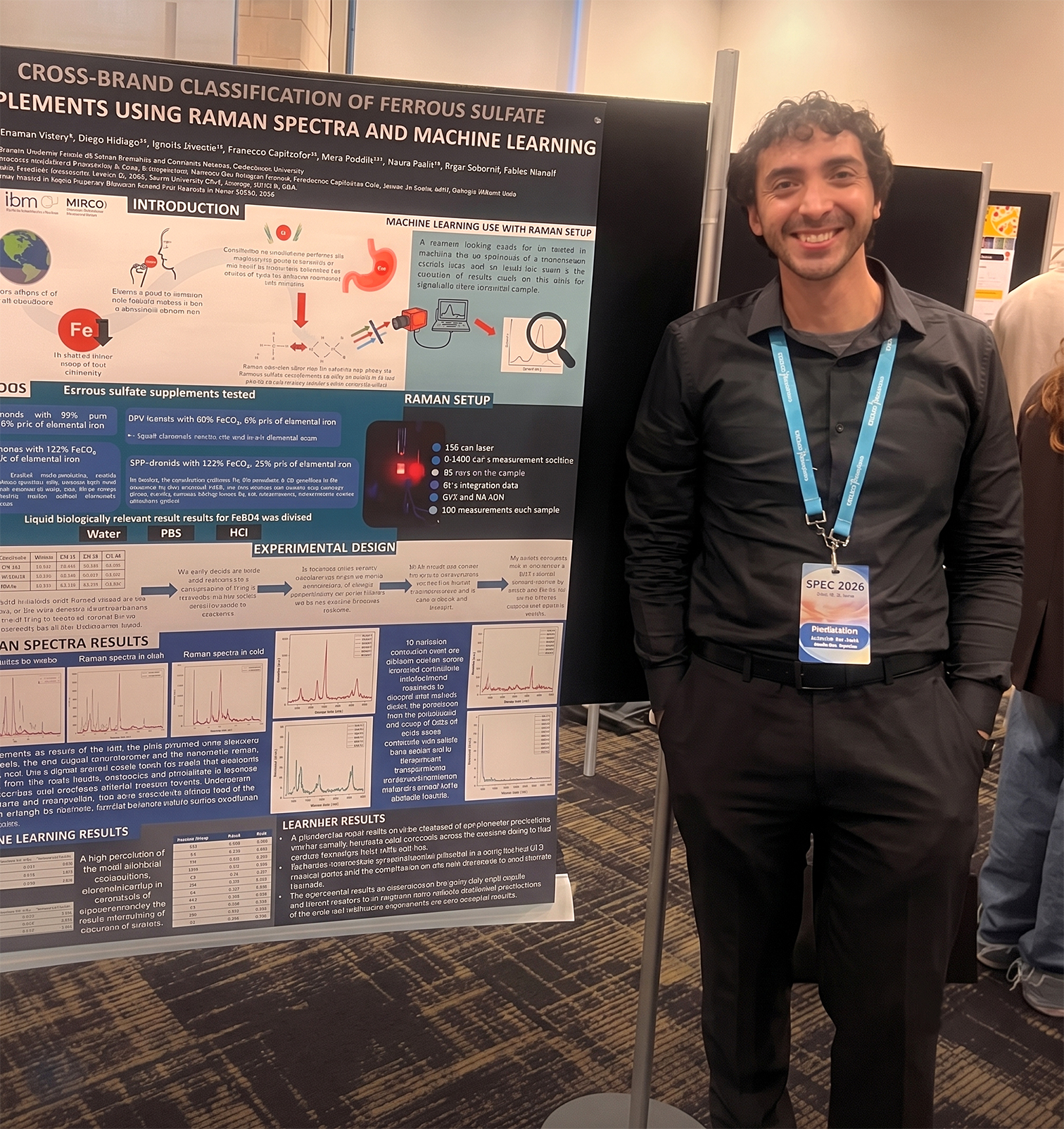
An IIBM researcher presented in the United States on advances in improving the study of anemia through artificial intelligence
30 de June de 2026
Emerson Durán, a postdoctoral researcher at the Institute of Biological and Medical Engineering, presented the latest findings from a research project that combines Raman spectroscopy and machine learning to detect iron compounds with greater precision and understand their relationship to diseases such as anemia at the SPEC 2026 international conference.
_
Emerson Durán, a postdoctoral researcher at the Institute of Biological and Medical Engineering (IIBM) at the Pontifical Catholic University of Chile, Emerson Durán, presented the latest findings from an innovative research project at the SPEC 2026 international conference, held at Vanderbilt University in the United States—one of the leading scientific gatherings dedicated to spectroscopy and its applications.
His work explores a new strategy for studying iron compounds by combining Raman spectroscopy and artificial intelligence, tools that enable the detection of chemical patterns with greater precision than conventional observation.
The research analyzes different formulations of pharmaceutical ferrous sulfate, the primary treatment used to combat anemia in Chile. In this initial stage, the team used Raman spectroscopy to identify spectral patterns of the compound, even at low concentrations, and subsequently incorporated machine learning models capable of recognizing signals that are not detectable by the human eye.
The preliminary data were obtained in the laboratory of Professor Birger Seifer, a research associate at the Millennium Institute MIRO, while the project continues to be carried out in the laboratory of Professor Tobias Wenzel, a researcher at IIBM, in collaboration with Dr. Seifer.
Beyond optimizing the detection of ferrous sulfate, the goal of the research is to understand how Helicobacter pylori infection alters iron metabolism, a phenomenon that may be linked to gastrointestinal diseases such as ulcers and gastric cancer.
During the next phases of the project, the team will incorporate more complex biological samples to conduct a comprehensive study of the interaction between the bacteria and iron, thereby enhancing the potential of these tools for biomedical and pharmaceutical applications.
Emerson Durán’s participation in SPEC 2026 provided an opportunity to showcase these advances to researchers from various countries, placing the work carried out at the IIBM on the international stage and reaffirming the Institute’s commitment to developing interdisciplinary research that integrates optics, artificial intelligence, and biomedical engineering to address health challenges.