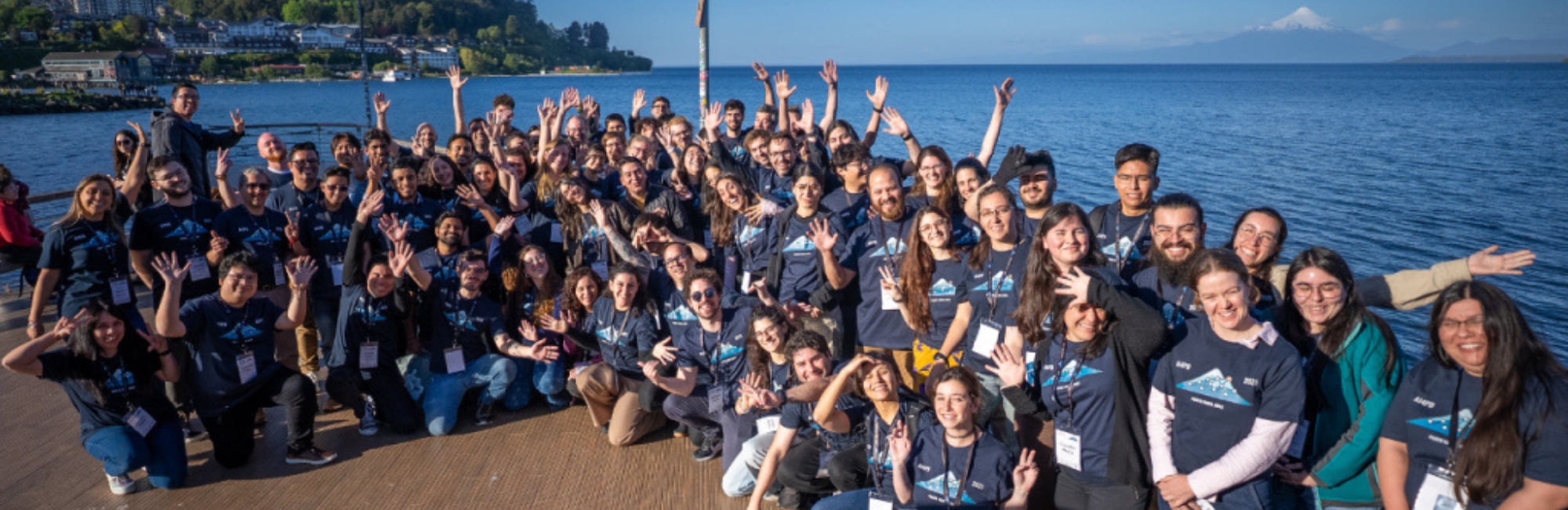
Connecting Frontiers in Protein Design in Latin America – AI4PD Workshop in Patagonia
28 de January de 2026
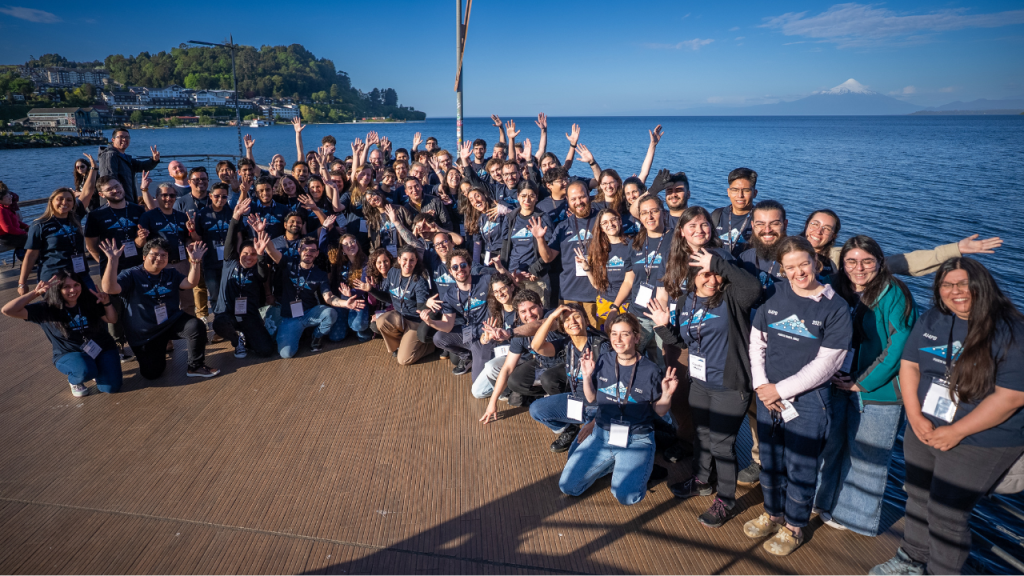
Puerto Varas, Chile - In November, the breathtaking landscapes of Chilean Patagonia, including Lake Llanquihue and the Osorno and Calbuco volcanoes, served as the backdrop for a high-impact scientific convergence. The EMBO Workshop: Latin American Workshop on AI for Protein Design (AI4PD) 2025
co-organized by RosettaCommons members - Cesar A. Ramirez-Sarmiento (Institute of Biological and Medical Engineering, UC Chile), Alena Khmelinskaia (LMU Munich) and Chris Bahl (AI Proteins Inc) - together with Nicole Lehna (Kura Biotech), brought together a vibrant community of researchers from different corners of the world to push the frontiers of computational structure prediction and protein design in Latin America.
This meeting, held between November 3 and 9, 2025 at the Bellavista Hotel in Puerto Varas, corresponds to the second version -from 2023- of a pioneering initiative aimed at training the next generation of scientists and scientists from Chile and Latin America in computational protein design. The workshop convened more than 55 students, postdoctoral researchers, academics and industry representatives, 44% of whom were women, selected from a total of more than 300 applications from the region and from different countries around the world. Among those selected, 31 were doctoral students from Chile, Argentina, Peru, Brazil, Ecuador and Colombia, along with participants from Japan. For five days, they worked side by side with 18 international experts on the latest artificial intelligence tools that are revolutionizing protein design, from prestigious institutions such as UCSF, Harvard, Johns Hopkins University, University of Washington, Leipzig University, TU Graz, LMU Munich and the Pontificia Universidad Católica de Chile.
A cutting-edge academic program in computational protein design
In recent years, artificial intelligence has profoundly transformed the study of proteins, making it possible to predict structures and design novel proteins - nonexistent in nature - to address contemporary biotechnological challenges. In this context, the workshop was conceived as an intensive and immersive experience throughout the week.

During the first three days of the workshop, participants were introduced to this rapidly evolving field through a combination of introductory lectures and hands-on tutorials. The program covered state-of-the-art tools such as Frame2Seq, ProteinMPNN and different versions of RFdiffusion, allowing to link theory with real applications in protein engineering and design, from peptides and antibodies to enzymes and macromolecular assemblies.
The Hackathon: collaboration in action
One of the highlights of AI4PD was the Hackathon, a space specially designed for participants to apply their new knowledge to concrete challenges. For many people, this was the highlight of the week, as it offered a realistic learning experience to face open problems, with the support of leading professionals in the area. Organized in groups of four, the teams worked on their own problems and protein design workflows, closing their projects with short presentations in a final session of flash talks. This activity also included a surprise online participation of David Baker, from the Institute for Protein Design at the University of Washington, who motivated and congratulated the attendees.
Feedback from the workshop was largely positive: 85% of the participants gave the highest rating to the introductory classes in terms of enjoyment, and 91% highlighted the speakers and instructors for their high level of knowledge and pedagogical effectiveness. Likewise, the Hackathon was valued as a unique opportunity to deepen the use of the tools, working collaboratively with peers and experts. The collaborative atmosphere generated in these sessions received the highest evaluation from 85% of the attendees, who indicated that it allowed them to gain a deeper understanding of the tools used.
Building community
Beyond code and chemistry, AI4PD was also an opportunity to build bridges and community. The choice of Puerto Varas provided an "academic retreat" environment that favored exchange and networking. From poster sessions accompanied by pizza and beer on Monday and Tuesday nights, to an excursion to the Alerce Andino National Park on Saturday, to a farewell party that evening, the environment facilitated a fluid dialogue between academia and industry.

As a result, 100% of participants stated that they would recommend future versions of the AI4PD workshop to colleagues; 100% indicated that they are likely to deepen their learning in these tools in the future; and 94% indicated that they expect to apply these protein design methodologies in their next research.
Some of the testimonies of the attendees highlighted that:
"The way the instructors were so friendly and attentive, coming to our stations to teach and explain step-by-step what we were doing, contributed greatly to my learning."
"Spending several days together with the other participants created a very pleasant environment to connect and share ideas in a meaningful way."
"I loved that it was one of the most up-to-date courses I have attended; it was great to see what is currently happening in the field of protein design."
The success of AI4PD 2025 demonstrates the enormous potential of the Latin American scientific community when it has access to cutting-edge training and global collaboration networks. We look forward to seeing the innovations that this new generation of protein designers will develop in the coming years.
Acknowledgments
This event would not have been possible without the support of our extraordinary collaborators, committed to the advancement of science in Latin America. We are especially grateful for the support of the European Molecular Biology Organization (EMBO) and RosettaCommons as main sponsors, as well as The Protein Society, the Institute of Biological and Medical Engineering of UC Chile IIBM, the Center for Bioinformatics and Integrative Biology of the Andrés Bello University, the School of Embedded Composite Artificial Intelligence (SECAI) of TU Dresden and Leipzig University, and the companies AI Proteins, Kura Biotech, Patagonia Biotech Hub, Google Colab, Hotel Bellavista and Cerveza Tropera.