IIBM student defends doctoral thesis on cell migration and mechanobiology
28 de April de 2026
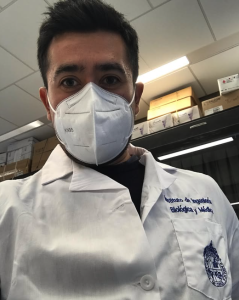
Patricio Canales, now a Doctor of the Institute of Biological and Medical Engineering (IIBM), recently defended his thesis entitled "Systematic Analysis of Epithelial Tissue Adhesive and Cohesive Properties and Their Interdependence", where he explores how the physical environment of cells affects the way they move.where he explores how the physical environment of cells affects the way they move.
Collective cell migration is key in processes such as scarring, embryonic development and diseases such as cancer. In his research, Canales analyzed how the stiffness of the extracellular matrix - the "support" where cells live - and the density of proteins influence both the speed and organization of this movement.
Using experimental models with epithelial cells and advanced analysis techniques, the study showed that not only does it change how fast cells move, but also how they move. In stiffer environments, for example, cells tend to move in a more orderly and directed fashion, whereas in softer conditions the movement is more disorganized.
In addition, the results show that these physical properties of the environment can activate molecular signals within cells, influencing their collective behavior. This is especially relevant in cancer, where tissues tend to become more rigid, favoring more persistent forms of invasion.
This work provides new clues to understanding how physical factors in the cellular environment can influence complex biological processes, opening up opportunities for future research in biomedicine and mechanobiology.
The research was supervised by Andrea Ravasio, in conjunction with thePhD Committee composed of Sebastián Aguayo, Deguchi Shinji, Marcela Torrejón and César Ramírez-Sarmiento, and co-supervision by Cristina Bertocchi. Also noteworthy is the collaboration of the Mechanobiology Institute of Singapore, where Patricio did a research internship under the guidance of Andrew Holle and Tsuyoshi Hirashima. Finally, the student thanked the support of the IIBM doctoral committee, which accompanied and supported his academic career.