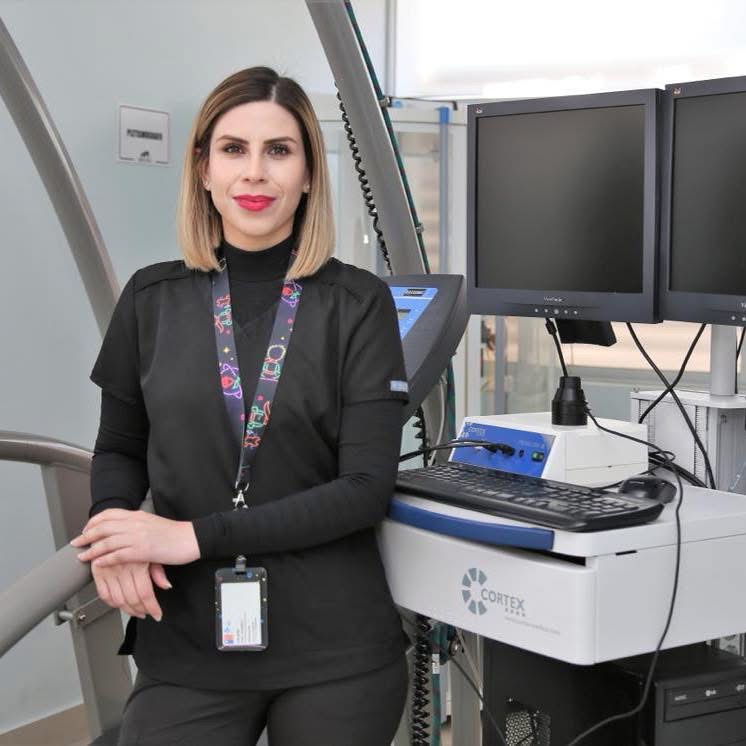
IIBM Ph.D. student presents thesis progress to her study committee
31 de March de 2026
Doctoral student Valeria Páez presented the progress of her research in the framework of the 2nd Annual Follow-up Activity, an academic event that brings together graduate students and research teams to present the progress of their work, promote the exchange of knowledge and strengthen scientific training. On this occasion, he presented his project entitled “Prediction of Psychophysiological Performance under Hypoxic Conditions: Integrating Autonomic, Cardiovascular, Respiratory and Cognitive Components”.
His thesis focuses on the study of physical and cognitive performance in simulated geographic altitude conditions, where oxygen availability in the environment and secondarily in tissues decreases. Through an interdisciplinary approach, the research integrates autonomic, cardiovascular, respiratory and cognitive variables, with the aim of predicting which subjects will perform better in these challenging environments. This approach allows not only to analyze physical and cognitive performance, but also to prevent altitude illnesses and generate better acclimatization strategies.
The work is supervised by PhD María Rodríguez, from the Pontificia Universidad Católica de Chile, and is co-supervised by PhD David Andrade, Director of the Center for Research in Physiology and High Altitude Medicine of the Universidad de Antofagasta. Likewise, the thesis committee is formed by academicians Francisco Sahli, Fernando Moraga, expert in chronic intermittent hypobaria exposure from Universidad Católica del Norte, Margarita Calvo and Tomás Egaña, who contribute from different areas of knowledge to the development and strengthening of the research.
The work of Valeria Páez seeks to provide scientific evidence to predict human performance in extreme conditions, which has relevant applications both in the field of high performance sports and in work and operational contexts that take place at altitude. In this sense, the research contributes to generate applicable knowledge in areas such as the preparation of athletes, the prevention of risks associated with exposure to hypoxia and the optimization of performance in demanding scenarios.
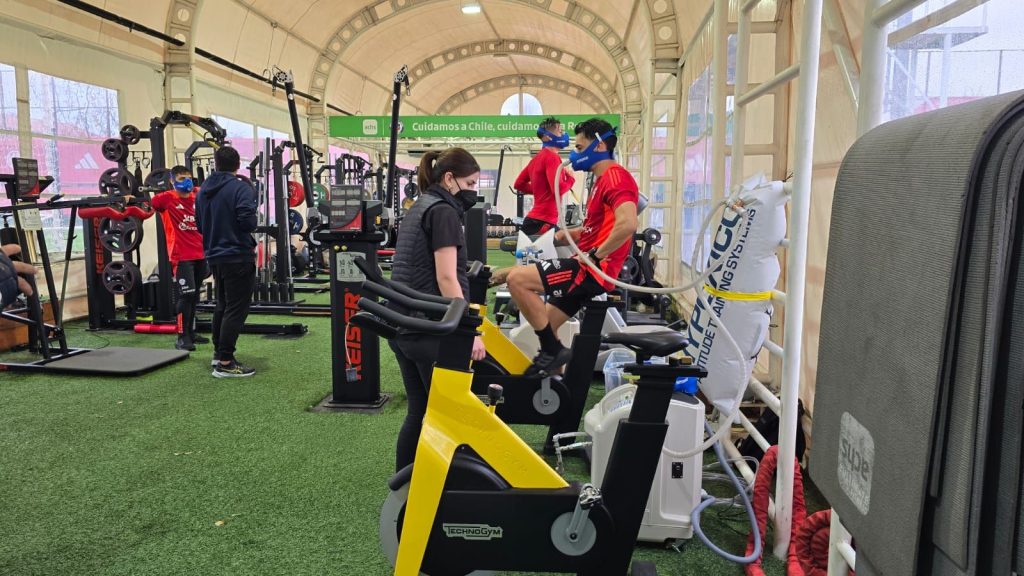
In the development of this research, collaborations have been established with leading national institutions, such as the Chilean Olympic Committee (COCH), through an acclimatization protocol with the adult national team prior to competition at high altitude and the FIMEDALT (Research Center for Physiology and Medicine at High Altitude). These alliances have made it possible to link academic research with real needs in the sports and scientific fields, facilitating access to data, infrastructure and relevant case studies.
Currently, the work is also being developed in conjunction with the Chilean Army Mountain School, which strengthens its application in real contexts linked to physical performance in extreme conditions. This collaboration makes it possible to evaluate the behavior of the organism in situations that require resistance, adaptation and decision making under pressure, providing a key practical dimension to the study.
Likewise, the research has included expeditions to various altitude locations, including Valle Nevado and San Pedro de Atacama. These field trips have been fundamental for the collection of data in real environmental conditions, allowing the analysis of physiological and cognitive variables directly in contexts of exposure to geographic altitude.
During these expeditions, measurement protocols that integrate cardiovascular, respiratory and cognitive monitoring have been implemented, which has allowed the construction of a robust and representative database. This methodological approach strengthens the validity of the results and contributes to generate more accurate predictive models of human performance at altitude.
The presentation of these advances at the 2nd Annual Follow-up Activity not only made the progress of the research visible, but also opened spaces for feedback with other researchers and academics, enriching the development of the project. This type of event is essential to strengthen postgraduate research and promote the generation of interdisciplinary knowledge with an impact on society.
In this way, the work of Valeria Paez is positioned as a relevant contribution to the study of human physiology in extreme conditions, integrating basic and applied science, and consolidating collaborative networks that enhance the development of high-level research in the country.